0 Comments

1. Introduction: A World at Our Fingertips, a Fragmented Mind

In a single minute, someone can reply to messages, read news from another part of the world, watch short videos, and find answers to questions that have just occurred to them. Such convenience once sounded like a vision of the future. Today, it all happens on a screen in our hands. Yet behind this convenience lies an important question: why does having access to more information make it harder to give our full attention to one thing?

The issue is not simply that younger generations are supposedly more easily bored. Digital environments are designed to keep offering something new. When attention moves from schoolwork to a notification, then to a video and a conversation, the mind must repeatedly readjust. This article explores that change without blaming either technology or its users.

Conceptual illustration generated with AI

2. Limitless Access: Opportunities Unlike Any Before

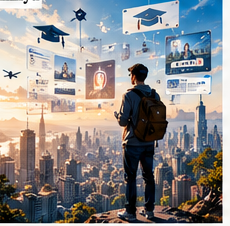
The internet opens doors to learning that were once difficult to reach. Someone in a small town can attend online lectures, learn a foreign language, read open-access journals, or start a business without a physical store. Skills that once required travel and significant expense can now be introduced through digital resources. For many people, this access represents a broader distribution of opportunity.

However, the availability of information does not automatically mean that it is understood. Saving dozens of articles is not the same as reading them deeply. Enrolling in many classes does not necessarily mean mastering a skill. We need to distinguish between collecting sources of knowledge and turning that knowledge into lasting ability.

Conceptual illustration generated with AI

3. Too Many Choices and Divided Attention

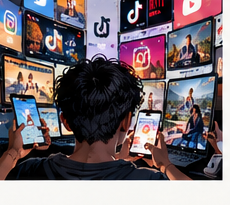
Every app offers a reason to keep looking at the screen: personalized recommendations, messages that feel urgent, or the next piece of content that might be more interesting. As a result, choosing to stop becomes harder. We often think we are taking a five-minute break, only to be surprised by how much more time has passed.

Switching between activities also carries a hidden cost. After leaving a task to check a phone, we cannot always return immediately to our previous train of thought. Attention must be rebuilt, especially when a task requires analysis, sustained reading, or writing. For that reason, visible busyness on a screen does not always correspond to meaningful progress.

Conceptual illustration generated with AI

4. Productivity, Mental Fatigue, and the Pressure to Always Be Available

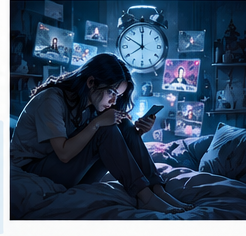
In educational and professional settings, quick responses are often treated as a sign of commitment. An unanswered message may trigger guilt even when we are working on something important. The pressure to remain available makes personal time and focused work easier to interrupt. Over time, this can increase fatigue and make work feel never-ending.

We should also be careful not to treat every difficulty with concentration as a medical disorder. Poor sleep, stress, noisy surroundings, digital habits, and heavy workloads can all affect attention. If concentration problems persist and significantly interfere with daily life, seeking professional guidance may be appropriate.

Conceptual illustration generated with AI

5. Why Does Something New Feel More Appealing?

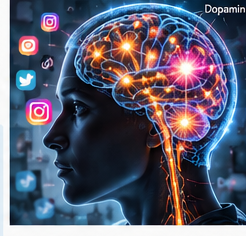
The human brain naturally pays attention to change and the possibility of gaining something valuable. Digital platforms build on this tendency through endless updates, recommendations, and rapid feedback. Dopamine is often mentioned in this discussion, but its role is more complex than that of a simple “happiness chemical.” It is involved in motivation, learning, and the anticipation of rewards.

Therefore, problems with focus cannot be explained by a single chemical or a single app. Habits, social needs, curiosity, and technological design interact with one another. Understanding this complexity matters so that our solutions do not simply revolve around blaming ourselves for lacking discipline.

Conceptual illustration generated with AI

6. Learning to Focus Again Amid Distractions

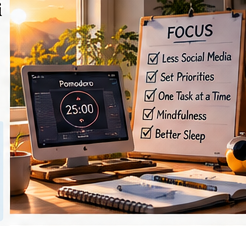
Focus does not mean rejecting all technology. What matters is the ability to decide when technology helps and when it takes over our attention. Simple steps include turning off nonessential notifications, keeping a phone out of reach during study sessions, and setting one clear goal before opening a laptop.

Time-blocking techniques, such as working for 25 minutes before taking a short break, can help some people get started. Yet no single method works for everyone. Some prefer longer periods of uninterrupted work, while others need more frequent breaks. The key is to observe our own patterns and build realistic habits.

Beyond managing devices, we need to rebuild patience for processes that do not offer instant results. Reading several pages of a book without switching apps, writing notes in our own words, or having a conversation without looking at a screen are small but meaningful exercises. The capacity to pay attention grows through repetition, not an overnight transformation.

Conceptual illustration generated with AI

7. Conclusion: Having Access Does Not Mean Using It All

Today’s generation has extraordinary opportunities to learn, create, and connect. The challenge is not a lack of information, but the courage to choose what deserves our time and attention. Not every message needs an immediate reply, not every trend must be followed, and not every opportunity has to be pursued at once.

Ultimately, digital freedom is not merely the ability to open anything at any time. Freedom also means being able to close the screen, sustain attention, and be fully present in one meaningful activity. In a world that offers everything, the ability to say “enough for now” may become one of our most valuable skills.

Conceptual illustration generated with AI

Leave a Reply

Related Posts

Learn from Google, Work for the World

Learn from Google, Work for the World How Google Career Certificates Open Unlimited Global Career Doors? The Workplace Has Changed—Has the Way You Learn Changed Too? Learn from Google Work for the World. A…