
Digital Loneliness
Why Are Humans Getting More Connected, but Getting Lonely?
Why do we feel alone in a world that is always online?

A quiet moment in a highly connected city. / A quiet moment in the middle of a city that is always connected.
MAIN QUESTION If we can reach almost anyone with a tap, why does it still feel so difficult to reach someone emotionally? / If we can reach almost anyone with just one touch, why does it feel so difficult to truly connect emotionally?
01 | The Paradox of Connectedness
We live in an age where distance is almost imperceptible. Messages can cross oceans in seconds, video calls can bring two continents to one screen, and social platforms can make thousands of people feel like they’re just one scroll away. But in the midst of that convenience, there’s an irony: many people find it increasingly difficult to find truly close relationships.
Imagine an ordinary evening: someone sits on a crowded train, surrounded by people, while their attention is fixed on a small, on-screen screen. Notifications come in, group chats move quickly, and stories continue to refresh. But when the phone is put down, the room may suddenly feel quiet. We can be very digitally active, but not necessarily feel emotionally accompanied.
This is the paradox at the core of digital loneliness. It’s not just not having internet friends or too much time online. It’s about the gap between the number of interactions we receive and the depth of connection we really need. In other words, being affordable is not the same as being understood.
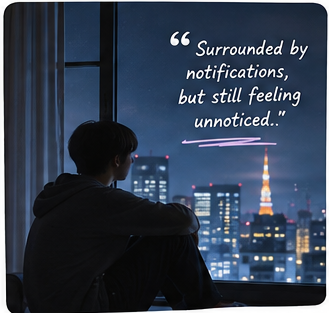
Being online can make us feel close to distant people, while the people beside us remain unnoticed.
02 | What Is Digital Loneliness?
Digital loneliness is a useful way to describe the feeling of disconnection that can arise in a highly connected digital environment. It is not a formal medical diagnosis, and it should not be treated as a label for everyone who enjoys social media. The term helps us talk about experiences when online interactions feel crowded, but the need for closeness, support, and understanding has not been met.
The World Health Organization distinguishes loneliness from social isolation. Social isolation refers to an objective lack of connection or contact, while loneliness is a subjective and disturbing feeling that the connections we have do not correspond to the connections we want or need. So, a person can have many friends and still feel lonely; on the other hand, a person who enjoys alone time does not necessarily experience loneliness.
This difference is important because the number of followers, contacts, or messages cannot measure the quality of a relationship. A person may receive dozens of reactions to a photo but still have no one to feel comfortable contacting when life gets tough. The deeper question is not “How many people can see me?” but rather “Who really knows me?”
SIMPLE DIFFERENCE Social isolation has to do with the quantity of contacts; loneliness is about the quality and adequacy of perceived connections. / Social isolation is concerned with the number of contacts, whereas loneliness is concerned with the perceived quality of relationships.
03 | Why Does This Happen?
There’s no single reason why digital life can feel lonely. Experiences are shaped by personal circumstances, the way platforms are designed, the quality of offline relationships, and the purpose behind our online behavior. Because of this, we need to look at some of the mechanisms that often come up—not to blame technology, but to understand how technology affects our habits.
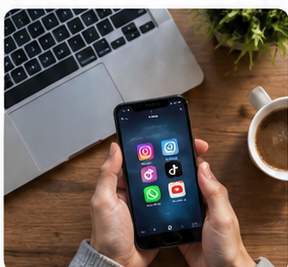
A smartphone offers many doors to communication—but opening a door is not the same as building a relationship.
A. Illusion of proximity
Brief likes, emojis, or brief replies can create small signals of attention. These signals are not meaningless; they can maintain contact and show support. But they may not provide the emotional depth that comes from listening, asking follow-up questions, remembering details, and staying present. We can feel momentarily cared for, but not necessarily feel understood.
B. Social comparison and spotlight
Social media often features selected moments: milestones, holidays, celebrations, interesting meals, and carefully framed selfies. We rarely see the full context behind those images—fights, uncertainties, mundane routines, or difficult days. When we compare our daily lives to other people’s edited highlights, it can create the impression that everyone is happier, more successful, and more connected than we are. Comparisons like these can make a person feel left behind, even though what they see is only a small part of someone else’s life.
C. Always available, rarely present
Being always reachable can blur the line between communication and attention. We might reply to a work message at dinner, check notifications while a friend is talking, or scroll through a family gathering. Our bodies are in one place, but our attention is constantly shifting to another. As a result, moments of togetherness lose some of their quality because the people who are present don’t get their full attention.
D. Fear of missing out (FOMO)
FOMO is the uncomfortable feeling that something interesting, important, or socially satisfying is happening without us. The constant stream of updates can make us feel like we have to keep checking in order to stay engaged. However, the more often we check what others are doing, the easier it is for us to miss the opportunity to be present in our own lives.
E. Communication without vulnerability
Digital communication can make it easy to share jokes, opinions, and brief updates while also making vulnerable conversations feel more difficult. Text messages allow us to edit, delay, or avoid difficult responses. Flexibility is useful, but deep relationships also require honesty, emotional risk, and the courage to say, “I’m not okay.” Sometimes, relationships become superficial not because we don’t talk, but because we rarely talk about things that really matter.
04 | What Does Research Say?
Research doesn’t support the simple conclusion that social media automatically causes loneliness. These relationships are complex: people may use digital platforms to maintain friendships, find community, and seek support; others may experience compulsive use, comparison, abuse, or interactions that don’t meet their emotional needs. So, the more pertinent question isn’t just how long someone has been online, but what they’re doing, why they’re doing it, and how they’re feeling afterwards.
A World Health Organization 2025 review reports that about one in six people worldwide experience loneliness, with young people reporting very high rates. The WHO also describes loneliness as a significant social and public health problem associated with poorer mental and physical health. The figures illustrate the breadth of loneliness problems in general—not digital loneliness specific numbers.
A systematic review and meta-analysis published in 2026 examined 59 studies involving 81,344 adolescents and young adults. The study found that problematic social media use had a moderate association with greater loneliness, while associations with time spent on social media were smaller. The authors also highlighted substantial variation across the various studies. That is, problematic usage patterns appear to be more relevant than simply counting minutes in front of a screen, but the correlation findings do not prove that one thing directly causes another.
This evidence invites a more balanced perspective: technology can support a sense of belonging, especially when distance, disability, migration, or limited local communities make direct contact difficult. At the same time, digital contact cannot always replace shared experiences, physical presence, and reliable support. Technology is not the enemy of human relationships; the challenge is to ensure technology helps us build relationships, not just fill time.
READ THE EVIDENCE CAREFULLY Association does not automatically mean cause and effect. Loneliness has many influences, including life transitions, health, income, community access, and relationship quality. / Statistical relationships are not evidence of cause-effect; loneliness is influenced by many factors.
05 | Impact: More Than Just a Bad Mood
Loneliness can affect the way people interpret everyday experiences. Delayed replies may feel like rejection, canceled plans can reinforce the belief that no one cares, and quiet weekends may seem like evidence that they’re falling behind. This interpretation isn’t always accurate, but repeated feelings of disconnection can make social situations feel more difficult. In the long run, a person can withdraw precisely when he or she needs support most.
Persistent loneliness has been linked to mental health challenges such as symptoms of depression and anxiety, as well as physical health risks. The WHO and public health agencies emphasize that social connections are an important part of overall well-being. However, it is important not to simplify all health problems into a consequence of social media use; a person’s condition is influenced by many interrelated factors.
Digital overload can also affect attention and rest. Late-night scrolling, frequent notifications, and the habit of checking the screen whenever there is a quiet moment can make it more difficult to create a space for reflection or sleep. That’s not to say every phone use will interfere with sleep, but uncontrolled habits can take a break and reduce opportunities to engage in energy-restoring activities.
At work or school, someone who feels disconnected may find it harder to ask for help, collaborate, or participate. In friendships, communication can be transactional: sending links, reacting to stories, or exchanging memes without checking how someone is doing. The absence of meaningful contact can make even a busy social calendar feel empty. Lots of interaction don’t necessarily mean a lot of support.
06 | Is Technology Always A Problem?
Absolutely not. Digital tools can be a lifeline. Migrant workers can stay close to cross-border families; a college student can find a study group; someone with a rare interest can meet a supportive community; and someone who feels unsafe in their surroundings may find peer information and support online. For some, the online space is the first place where they feel welcome. Therefore, a healthy solution is not to ban technology, but rather to understand when technology helps and when its use begins to replace other needs.
The same platform can create a very different experience. Video calls with close friends can reduce distance, while endless comparisons with strangers can exacerbate self-doubt. Group chats can provide practical support, while a high-notch work channel can create pressure. The value of digital interactions depends on their purpose, context, and emotional qualities. So, platforms aren’t the only determinants; how we use them is also important.
A useful question to ask is: after using this app, do I feel informed, supported, inspired, or connected—or do I feel restless, inadequate, distracted, and more alone? These small reflections can help us notice patterns without judging ourselves. Mindfulness is the first step to realistically changing digital habits.
07 | How to Rebuild Meaningful Connections
The goal is not to go completely offline. The goal is to make digital life serve human life. Small, repeatable actions are often more effective than dramatic detox plans that are hard to maintain. We can start with simple habits that leave more room for real relationships.
A. Choose depth from the figures
Instead of measuring connections by followers or number of messages, invest in some relationships where honesty and shared care allow. Send a private message, ask specific questions, or set up a conversation that goes beyond “How are you?” Try to reach out to someone not only when they need something, but also to find out how they are doing sincerely.
B. Turn digital contacts into real interactions
If the conversation is important, consider providing voice notes, phone calls, or video calls rather than relying solely on short reactions. If possible, plan a walk, coffee, a meal together, or an activity. Not all friendships require frequent face-to-face meetings, but shared experiences can add warmth and context to online communication. Make the chat a bridge to closeness, not the only place where the relationship takes place.
C. Create notification limits
Turn off unimportant alerts, set a specific time to check messages, and protect moments like meals, study sessions, and the first or last part of the day. Boundaries aren’t rejections of others; they’re ways to give more deliberate attention. We don’t always have to be available to be a caring friend, coworker, or family member.
D. Fully present practice
When spending time with someone, put your phone out of reach and listen without preparing for the next reply. Pay attention to the tone, pauses, facial expressions, and details that don’t make it into a text message. Full presence often feels simple, but that’s exactly what makes the other person feel appreciated.
E. Join a community built around shared activities
Classes, sports groups, volunteer projects, book clubs, language exchanges, or creative workshops give people a reason to meet over and over again. Repeated contact with low pressure can help trust grow naturally. If you’re not comfortable building close friendships right away, start with activities together; relationships often grow from the habit of being present in the same space.
F. Learn to ask for support
Sometimes the most meaningful step is a direct sentence: “I’ve been feeling disconnected lately. Can we talk?” People can’t always guess what we need. If loneliness feels persistent, overwhelming, or affects daily functioning, talking to a trusted person or a qualified mental health professional can be helpful. Asking for help isn’t a sign of weakness; it’s a form of self-concern.
G. Make room for healthy solitude
Being alone doesn’t automatically equate to loneliness. Loneliness can be healing if it’s chosen and meaningful—reading, walking, cooking, journaling, or simply taking a break without needing to document the moment. We don’t have to fill every pause with a screen. Sometimes, learning to enjoy our own company makes it easier for us to connect with others without relying on constant validation.
08 | Seven Day Connection Reset
Try this as a gentle experiment, not a strict challenge. The goal is to notice what changes as attention becomes more deliberate. It doesn’t have to be perfect; choose a realistic step and adapt it to your individual needs.
- Day 1 — Alert: Track when and why you reach for your phone. Take note of the situation that makes you open the app automatically.
- Day 2 — Contact you: Send a thoughtful message to someone you miss. Ask how you are doing with specific questions.
- Day 3 — Protect for a moment: Keep one meal or one conversation without a phone. Give your full attention to the person you’re with.
- Day 4 — Curate your feed: Mute accounts that repeatedly trigger unhealthy comparisons. Follow accounts that provide knowledge, inspiration, or support.
- Day 5 — Meet through activities: Invite someone for a walk, coffee, study, or hobby together. Start with a simple meeting.
- Day 6 — Enjoy offline time: Spend at least 30 minutes doing something without documenting it. Enjoy the experience without having to upload it.
- Day 7 — Reflection: Ask: which interactions make me feel seen and supported? Maintain habits that really help.
09 | Conclusion: Connected, but Not Disconnected from Self
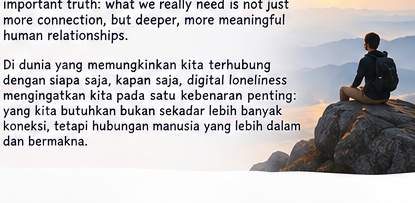
Sometimes reconnection starts with looking up from the screen and noticing the world around us.
Digital loneliness reminds us that connections aren’t just technical achievements. We can have fast internet, multiple accounts, and hundreds of conversations while still longing for one safe space where we can talk honestly. The human need isn’t just to be noticed; it’s to be understood, accepted, and supported. We need not only someone who sees our posts, but also someone who is willing to listen to the story behind them.
Technology has made communication easier, but meaningful connections still demand something from us: time, attention, patience, empathy, and vulnerability. We don’t need to leave the digital world. We need to use them with intention, in order to help us get closer to others rather than preoccupy us with the impression of closeness. Ultimately, the quality of a relationship is not determined by how quickly we respond to messages, but rather by how sincere we are.
FINAL THOUGHTS Don’t measure your social life by how many notifications you receive. Measure it by whether you have people you can talk to to be real. / Don’t measure your social life by the number of notifications, but by the existence of people who make us who we can be.
Further Reading
World Health Organization. (June 30, 2025). Social connections: Questions and answers. https://www.who.int/news-room/questions-and-answers/item/social-connection
World Health Organization. (2025). From loneliness to social connection: Mapping the path to a healthier society. Report of the WHO Commission on Social Connections. https://www.who.int/publications/i/item/978240112360/
Feng, H.-P., et al. (2026). Exploring the relationship between social media use and loneliness in adolescents and young adults: A systematic review and meta-analysis. Social Psychiatry and Psychiatric Epidemiology, 61, 1345–1359. https://doi.org/10.1007/s00127-026-03175-4
Hall, J. A. (2025). Loneliness and social media. Annals of the New York Academy of Sciences, 1543(1), 5–16. https://doi.org/10.1111/nyas.15275
Centers for Disease Control and Prevention. (May 15, 2024). Health Impacts of Social Isolation and Loneliness. https://www.cdc.gov/social-connectedness/risk-factors/index.html
Editorial note: This article is educational and is not a clinical diagnosis or a substitute for professional mental health advice.
These images are illustrative visuals created for this article.
Related Posts
Nemawashi: Why Are Major Decisions Often Started Through Unseen Conversations?
Bilingual articleNemawashi is one of the most interesting concepts in Japanese organizational communication because it shows that the quality of a decision is often shaped before the decision ever reaches the formal agenda. This…
A Generation That Can Access Everything, Yet Struggles to Focus on One Thing
1. Introduction: A World at Our Fingertips, a Fragmented MindIn a single minute, someone can reply to messages, read news from another part of the world, watch short videos, and find answers to questions…
Learn from Google, Work for the World
Learn from Google, Work for the World How Google Career Certificates Open Unlimited Global Career Doors? The Workplace Has Changed—Has the Way You Learn Changed Too? Learn from Google Work for the World. A…